Explore the possibilities.

Never be afraid to choose a road that nobody chooses.

Challenge new boundaries

Nobody knows what lies beyond.

There is always something new every day.

Pay attention to little details in your life and appreciate them.

Share the knowledge.

It is always fun to talk to someone who knows the subject as well as you do.

Be excited, and remember the excitement.

Never say you're too old to do something.

Showing posts with label chinese. Show all posts

Wednesday, October 9, 2013

Instant Noodle Around the World 17 - Kang Shi Fu Braised Beef Cup Noodle

Edit: 
The name of the brand is Kang Shi Fu, or "Master Kang". The flavour is "hong shao niu rou", or translated as "braised beef". However, 'hong shao" meat is normally braised with spices including chilli peppers. That's why I thought the Chinese letters meant "spicy beef soup". The beauty of sharing through internet: quick gain of information. Thanks to my Singaporean friend for the help!


There are three packages inside, one for powdered seasoning, one for dehydrated vegetables and the last one for the wet seasoning.


It was quite difficult to get all of the wet seasoning out because it forms a solid clump that doesn't flow even if you squeeze the packaging. Maybe the low temperature (right now it's about 12 degrees C outside and I don't turn my heater on) caused the oil to solidify. Normally, I'd get it out using my chopstick/fork. It doesn't kill to have a clump, but I find it a little bit annoying. 


The noodle has a great texture, and the level of spiciness is just fine for me. I would say that in terms of spiciniess, it is slightly above Shin Ramyun. The noodle is pretty chewy, but not as chewy as Shin Ramyun. The rehydrated vegetables have acceptable texture (of course you can't expect too much from rehydrated vegetables), and surprisingly, there are also beef pieces in there. The beef must have been in the wet seasoning. Its texture is similar to overcooked minced beef: a little too hard and perhaps a little rubbery, and it lacks the juiciness of a freshly cooked beef.

Overall, the flavour is great. However, one of the drawbacks is that if you eat this in a room that is quite cold, the soup will cool down pretty fast and then you will end up looking at a pool of oil mixed with some solid fats floating on top of the soup. In many of Chinese cuisines, the spiciness in the dish is delivered through spiced oils, and a lot of flavour compounds are dissolved in the oil. So if you don't eat the soup together with the floating oil/fats, the soup doesn't taste as great as it should be.

But I guess this problem applies to other brands with similar flavour concept.

The ingredient list is in Dutch, and although I don't really understand Dutch, it's better than reading it in Chinese because then even Google Translate would not be helpful at all. Anyways, reading the ingredient list is one of my ways to slowly learn Dutch without taking any lessons.


Noodle: tarwemeel (wheat flour), geraffinneerde palm olie (refined palm oil), zetmeel (starch), zout (salt), kaliumcarbonaat (calium carbonate), natrium tripolyphosphate (sodium tripolyphosphate), kruiden (spices), b caroteen (beta carotene)

Sauce pack: geraffinneerde palm olie (refined palm oil), sjalot (shallot), zout (salt), smaakversterker E621 (flavour enhancer)

Soup pack: zout (salt), smaakversterker E621 (flavour enhancer), suiker (sugar), kruiden (spices), specerijen (spices), gevriesdroogd groenten (lyophilized/dehydrated vegetables)

So, some ingredients sound new to me. There is a Codex (standard) for instant noodle, in which instant noodle, its ingredients and its properties are defined. To make it easier to understand, a Codex for butter would indicate that in order for a product to be called butter, it has to contain 80% fat. So if something is below 80%, even though it looks like butter, you may not call it a butter.

The Codex for instant noodle is Codex STAN 249-2006_1. If you are interested, you can Google it. Otherwise, you can try this link. The document is fairly easy to understand, even if you are not familiar with the food industry. So here's what I found:
  • calium carbonate: possibly acidity regulators, since sodium carbonate and potassium carbonate are typically used as acidity regulators. These compounds have the potential to lower the acidity of the product.
  • sodium tripolyphosphate: a humectant (a substance that keeps things moist)
I'm not sure of the differences between kruiden and specerijen. This might be an interesting topic to cover. Apparently, according to my Polish friend, kruiden = herbs and specerijen = spices.

But you know what's weird? There are three packs of condiments inside the cup noodle, as I mentioned earlier and showed in the photo. However, there are only two packs listed. Also, I remember very clearly that I was fishing for the meat pieces from the soup. Where did the beef go in the ingredients list? Was there a translation error, or was it also not included in the original text? I don't know. I threw the packaging away and there is no way I could translate the Chinese characters. I don't even know how to type them into Google Translate LOL. Well, if you understand Chinese, and you bought this instant noodle, please let me know what it says on the ingredients list.

After writing this post, I was thinking... Maybe I should have a post for Instant Noodle 101 and try to bust some stupid myths and hoaxes floating around the internet, like "a wax is sprayed on the noodle to make the noodle appear better and last longer, so when you boil the noodle you see oil droplets floating". This is not true because the oil droplets resulted from frying the noodles during the process of making instant noodles. 

Friday, November 30, 2012

The Netherlands - Brain Tonic Mushroom Soup

I forgot to include this interesting story about finding a brain tonic herbal soup mix in Den Haag's China Town. 


I can't read Chinese characters, especially when they are too fancy. I can only read a word that means "monkey head mushroom" and "brain". The rest looked like some encrypted ancient language to me. Lucky enough, I was there with a friend from China. She translated almost everything on the package, and it says that it can improve your brain and also make you smarter. Ha!


The only ingredient I recognize was monkey head mushroom and golden mushroom. And it's actually pretty weird they didn't include goji berry in the ingredients list even though I clearly saw goji berries (on the first picture, the red seed-like dried fruits at the bottom of the package). The rest of ingredients can actually be found in Google and Wikipedia (and I'm actually quite surprised I was able to find good information about those ingredients).


All of the ingredients for Chinese herbal soups are normally preserved by drying. In this case, I have to rehydrate the monkey head mushroom (above) separately in a bowl of water for 10 minutes, then squeeze out the water from the mushroom. They call it monkey head mushroom because when it is at its original or rehydrated state, if you rub the caps, you feel like rubbing a monkey's hairy head :)


The ingredients were nicely and individually packaged. It made me think that this herbal soup premix is actually of high quality. The goji berries also look fresh (they are bright red; some poor quality goji berries look pale orange and are shrunk too much).

In the English instruction, they only said "add lean pork meat" into the soup but when my Chinese friend read the instruction written in Chinese, it actually said "add lean pork or chicken meat" into the soup. Why would they change the instructions? Is pork meat better for English speaking communities? LOL. Lost in translation.


I simmered the soup in low heat for 3 hours. It's very delicious (to me, who is used to drinking herbal soup since young). It's slightly earthy but also sweet because of the goji berries.

Do I feel smarter? Well, you tell me. I left my favorite gloves in an iceskating rink 1.5 hours away by car from Wageningen during an iceskating rink event organized by Thymos, a sports association in my university, a week after I drank this soup. It definitely doesn't improve my short term memory. But hey, it tastes great. I don't mind eating this soup again :D

Friday, November 16, 2012

Instant Noodle around the World 12 - Pork Bone Soup

This is the non-spicy version of Instant Noodle around the World part 11. At first I was hesitant to eat this because of maldigestion problem I suffered after eating the spicy version of this noodle of the same brand. Wasting food is a big taboo for me, so I decided to give it a go.


Instead of chili in oil, there was a pack of dehydrated veggies (cabbage, carrots and scallion). Well, this looked healthier than the spicy version.


Almost everything else from the ingredients list are similar, but no chili oil and chili powder in the seasonings.


Again, there was no nutrition label visible on the packaging and I'm pretty surprised this product went through the EU. As far as I know, food law in EU is known to be very strict compared to the already-strict FDA in the United States.

Well, time to dig in...


It did not taste really great. The pork bone flavor was more noticeable in this version than in the spicy version, although I felt that it lacked something. The dehydrated vegetables rehydrated pretty well - they didn't feel rubbery or exceptionally hard (like the ones you find in Indomie Special Mie Keriting). The noodle was chewy despite being thin and I like chewy noodles.

Although this one is supposed to have less oil, you can clearly see big oil droplets floating on the soup. In the end I didn't finish the soup because I felt traumatized from the spicy version.

Will I buy it again? Probably not. It's not very outstanding. There are still more instant noodles to try out there!

Thursday, November 15, 2012

Instant Noodle around the World 11 - Spicy Pork Bone

I'm back with more instant noodles from China. It's unfortunate that I can't read any of the characters but the flavor: Spicy Pork Bone.


I wish they have some pinyi attached to the packaging. This way I can only say to people "I bought a Chinese-brand instant noodle. Anyone who can read it, please let me know what the brand is called :)


The portion was kind of big. The noodle's thickness was average, perhaps slightly thinner than average. The seasonings were well packed. The red packet contains non-dehydrated chili in oil, vacuum packed in aluminum. It's quite a high quality packaging. There was the oil-based seasoning (at current temperature in the Netherlands I'd say it's fat-based rather than oil-based) and about 25-35% of what's inside the package was fats. And then lastly there was powder seasoning. Of all three, the powder seasoning had the lowest grade of packaging material.


Verdict? Spicy. Really spicy. I think this is spicier than Shin Ramyun. It's a little sour, but not to the point I'd call this hot and sour soup. The noodle was surprisingly chewy despite the rather thin appearance.

You can't really tell from this picture, but once I started stirring the chili and oil into the noodle, the soup became pretty thick (pickering emulsion - too much fat droplets makes the soup thick - learnt that in class last period). I can taste the pork bone flavor, which is great. I think overall this instant noodle had great flavor - if it could be a little less oily. A lot of spicy Chinese food relies on chili oil if not the chili pepper itself (all Sichuan foods are oily, as far as I know). I guess that makes Chinese spicy flavor delivery its uniqueness.


And oh, there was no cooking instruction on the package. Either that, or the annoying translated label covered it.


Reading this makes me think more about the use of palm oil in instant noodles. Palm oil production has been considered not nature-friendly because making oil palm plantation costs massive area of forest and its habitats. Palm oil has also about 50% saturated fats, which is one of the risk factors of cardiovascular disease (just learned that in class!). 

And actually there was another story to tell about this. I'm not 100% sure that this instant noodle was the real culprit, but later on the same day I had this instant noodle for lunch, I suffered from serious fat maldigestion. I don't really want to talk about the symptoms because it's pretty... disgusting. If you are interested to know, just Google it, or you can read it here. It's pretty ironic because the morning before I had this instant noodle I just learned everything about fat maldigestion in class. And 5 hours later, I had a first-hand experience suffering fat maldigestion.

I hoped to see a nutrition content label on the packaging but I couldn't find it. But I really think the amount of fats in this instant noodle was pretty absurd.

Will I buy it again? No, thanks. I don't want to risk myself suffering another fat maldigestion. It was a horrible 2-day experience.

Saturday, November 10, 2012

Instant Noodle around the World 10 - Chinese Pickled Cabbage & Fish Sweet Potato Noodle

We went to The Hague about two weeks ago to get our Irish visa ready for January. On the way back, we found China Town and I asked them if I could stop by the Chinese groceries store. The shops in Wageningen, the town where I am right now, are small and they don't have a wide variety of goods. I got nice stuffs like kimchi and bean curds. Then I saw my Chinese friend hugging a lot of this instant noodle:


My friend said this instant noodle is very, very, very delicious. All the more the reason to try it :D

Although maybe people who are not adventurous enough might find the name of the flavor to be rather exotic.

Since I bought this in the Netherlands, they replaced the ingredients list in Dutch with a sticker. 


I do understand a little bit of Dutch, but not too much. I had to peel it off to see what's in there. It's quite annoying to do this every single time I buy exported goods in the Netherlands.


The first thing I notice was, naturally, the letters in capital. Ooh yeah, all sort of flavor enhancer, the family of monosodium glutamate (MSG). No wonder it's delicious. But hey it's not a reason not to try. After all, I don't eat instant noodle every day. I'll just have to drink a lot of water afterwards! Then it will (hopefully) be flushed out of the system.

Inside the packaging are the sweet potato noodles, powder seasoning, wet seasoning and pickled cabbage in the green package. 


I'm not entire sure what's in the wet seasoning but it is a little spicy. It's delicious.

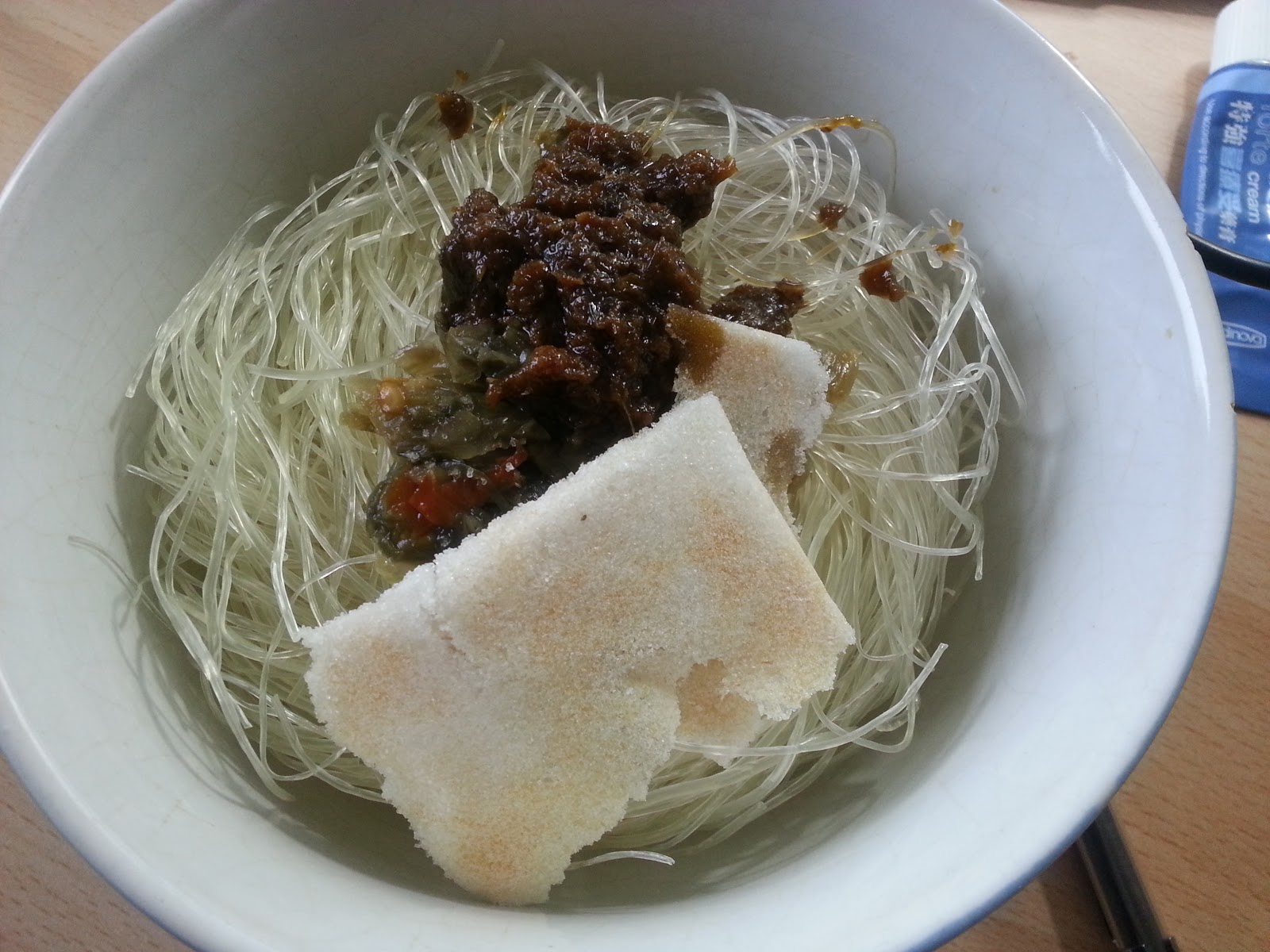
The sweet potato noodle look like thin rice / mung bean vermicelli. Sweet potato instant noodles are quite rare; most instant noodles I see in the market are made of wheat. The only other sweet potato instant noodle I had seen (and tried) was Korean, and it's served cold.


I'd like to say that the packaging for the powder seasoning was really poor. Do you see that chunk of white/brownish flake below?


Yup, the powder seasoning had undergone caking (absorbs water and becomes one giant chunk of solid instead of a powder). But it doesn't really matter since this kind of seasoning readily dissolved in hot water even at this state.

The cooking method was also different: pour boiling water into the bowl with everything inside, leave it for 5-6 minutes. I was getting impatient because usually instant noodles take only 3 minutes to cook. It's worth the wait, I say.


The soup looks dark and the overal appearance just didn't look quite appetizing, but once you put it in your mouth... ooh la la! YUMMY!!

The only biggest concern here is the amount of saturated fat and sodium. They are really high. That's why don't eat this every day. Have it as an occasional treat comfort food ;)


I will buy it again if I find it, but I will not buy in large quantity just because there are still a lot of instant noodles around the world to discover!

Monday, May 2, 2011

Finishing Up

I have to clear out all my food stocks before I graduate. Hhh.... I have so much leftover glutinous rice from my soy snack extrusion research project. 

Last Friday I attempted to make lo mai kai but I forgot that last week my fridge refused to cool my stuffs because of ice formation in the freezer, so I had no meat to work with. But I still have some Chinese sausages and dried shiitake mushrooms - they never go bad easily.


Ingredients:
- 1 cup glutinous rice
- 1 Tbsp cooking oil
- 1 pork sausage, sliced
- 4 cloves garlic, minced
- 2 cloves shallots, minced
- 4 dried mushrooms, rehydrated and sliced
- 2 Tbsp oyster sauce
- 1 Tbsp rice wine
- 2 Tbsp sesame oil
- 1 tsp white pepper
- 2 tsp sugar
- 1 tsp salt

Steps:
1) Soak glutinous rice overnight (the water must completely cover the rice).
2) Drain the water from glutinous rice and steam for 40 minutes.
3) Meanwhile, sautee pork sausage, garlic, shallot and mushroom for about 3-5 minutes.
4) Take the glutinous rice out of the steamer. Add oyster sauce, rice wine, sesame oil, white pepper, sugar and salt into the steamed glutinous rice, and mix well. Note that at this point the glutinous rice should be a little hard because it will be steamed again. And as usual, the seasoning measurements are very flexible. Please adjust according to your taste :)
5) Mix sauteed ingredients from step 3 into the glutinous rice, and pack them into small bowls (or big bowl - depending on the way you want to serve the lo mai kai). Press it down the bowl so the glutinous rice is well-packed.
6) Steam the bowls for another 20 minutes.

These can be micowaved too, so it's okay to prepare them in advance :)

Wednesday, April 20, 2011

Steam!

I really miss long chili pepper stuffed with minced pork seasoned in soy sauce, white peppers and sesame oil, and then steamed. Childhood favorite ♪


I'm not a big fan of my steamer. The holed base would suddenly fall down and then I have to pull the base from the bottom of the pot using strings because it's stuck at the bottom :(

I tried to make manju again (to test my perseverance). This time I used chestnut and red bean fillings. I can't believe I failed 4 times making the dough because I strictly followed the recipe. That's what you're supposed to do when you want to bake but NO! I used my instinct to measure how much flour I should put and my sense was right! This time it turned out in a pretty good shape, BUT...


THE BAKING SODA MAKES THE BREADING BITTER!!

I don't know what's wrong with my baking soda. It's a cheap Chinese brand baking soda. I'm throwing it away *cries*