Explore the possibilities.

Never be afraid to choose a road that nobody chooses.

Challenge new boundaries

Nobody knows what lies beyond.

There is always something new every day.

Pay attention to little details in your life and appreciate them.

Share the knowledge.

It is always fun to talk to someone who knows the subject as well as you do.

Be excited, and remember the excitement.

Never say you're too old to do something.

Showing posts with label sushi. Show all posts

Friday, November 16, 2012

The Netherlands - All You Can Eat Sushi @ SUMO

Finding good sushi in a small town like Wageningen is proven to be difficult. One day I went to Rotterdam for a sight-seeing trip and found this well-rumored restaurant called SUMO. From what I found, SUMO is a large all-you-can-eat sushi chain in the Netherlands. 

The all-you-can-eat system here is different from what I'm used to in Singapore and Indonesia, where you just order whatever you like or grab the plates from the rotating conveyor belt, with no time limits, and refillable hot tea. Here in the Netherlands, most all-you-can-eat restaurants do it by rounds.

In this restaurant, you are given 6 rounds per person, and on each round you can order 5 dishes on the menu. Lunches are normally cheaper by about 5 euro because some menu are not available (and they're normally the ones you really want to eat). So in total you will have 30 plates per person.

The first time we came to SUMO, there were six of us. For each round we had to order 5 x 6 = 30 plates, and our table was constantly full. In total, if we went full course for 6 rounds, there would be 6 x 30 = 180 plates, but no one was insane enough to survive round 6. We gave up at round 4, so in total there were 120 plates on our table. For 18.50 euros, it's really worth the money because seafood is very expensive in the Netherlands and a plate of sashimi costs you 12.50 euros. with an extra 6 euros, you can beat yourself to death with sushi.

Of course, the limitation was the drinks. We ordered a pot of green tea each, and by round 2 there was no more tea. And it's not refillable. To top it up, the pot was actually super small. If you measure the volume capacity of the pot, it's actually equivalent to a small mug. The cheapest drink you can get is 2.50, so... yeah, drinks can cost you a lot in this restaurant. But otherwise they will earn no profit and you cannot eat anymore good sushi around :(

They serve "basic" sushi like nigirizushi, makizushi (rolled) and temaki (cone shaped). 


I must say that the quality of the fish was excellent. It was very fresh (no sign of defrosting, like the one I had in Ede), and they didn't just give you tiny cuts of fish. The fish completely covered the rice portion of the sushi (and even way beyond the rice) in case of nigirizushi. 


The sushi rolls were pretty good, although I saw very little difference between crunchy tuna and cream cheese tuna aside from the avocado in crunchy tuna replaced by cream cheese, and the addition of white sesame seeds coating the surface of cream cheese tuna. And spicy tuna rolls were basically crunchy tuna without the crunchy fried tempura batter, basted in chili powder.


They also serve warm food like usuyaki beef (beef roll with asparagus inside), yakitori, beef teriyaki and gyoza.


I don't really recommend the salads because most of them contain meats anyways, and the only fresh-looking salad available, sunomono, is unbelievably sour. It's like drinking vinegar straight from the bottle. 


BUT it tasted good after eating deep fried, oily foods. It helps you to eat more, so it's worth getting after the second round :)

You can see the menu here, or download it straight from the website for more info.

It's worth the money. Really :D

Wednesday, May 16, 2012

In Japan - Fresh Wasabi

I was wandering around Tsukiji Fish Market last Saturday and got a piece of fresh wasabi for 735 yen. That was the cheapest I could find. From my observation, normally the smaller wasabi roots cost less. I've seen bigger wasabi root than this, and if I wasn't mistaken it was around 1200 yen.


It's green, but somehow it's not as green as the fake wasabi (it's actually horseradish colored with green coloring) we see at sushi shops. I thought it would be hard to peel, but it's actually easier than peeling ginger root.


I bought a mini oroshiki (grater) suitable to make grated wasabi or ginger from 100 yen shops (honestly, those shops are amazing; maybe I should cover it someday).


It's hard to tell from the picture, but the green color gets more intense as it gets to the top. I'm not sure why.


It took me about 5 minutes to get everything grated. It was quite a painful journey because my eyes are pretty sensitive to volatile irritants. I always cry whenever I cut onions. Well, this time, rather than getting volatile irritants into my eyes directly, the smell of the wasabi struck my nose and it induced me to cry.


Compared to the wasabi used at many sushi shops, this grated wasabi look coarser and dryer. In terms of volatile compounds, because it's not chilled I can smell the sharp, offensive wasabi smell better. As for the taste, surprisingly it is not as striking as the ones used in sushi shops. Somehow it has a very smooth spiciness.

Worth the money? Well, I'm not a big fan of wasabi and I couldn't think of any applications other than as salad dressings and fried rice component. I just made fried rice with egg, wasabi, shouyu, nori, shredded crab stick and green onions. Delicioso.


Saturday, May 12, 2012

In Japan - Tsukiji Fish Market

First of all, you can find out more about the famous Tsukiji Fish Market from its official website  (http://www.tsukiji-market.or.jp/) or many other guides written on the internet or books. It's important to check in advance because:

1) It closes on Sunday and on public holidays. The Fish Market has a calendar (only in Japanese: http://www.tsukiji-market.or.jp/etc/calendar/2012.html). Don't make yourself travelled all the way Tsukiji only to find out that it's closed.

2) If you are aiming to see the auction, it starts at 5 a.m. and if the maximum capacity has been reached, you will not be able to enter anymore. For more information, you can visit this page (http://www.tsukiji-market.or.jp/youkoso/24hour_e/24hours.htm) or according to the market map given free at Tsukiji Fish Market entrance, the reception starts at 5.a.m. and visiting hours is from 5:25 a.m. to 6:15 a.m. Make sure not to miss it!


From Tsukiji Station on Hibiya Line of Tokyo Metro, turn left and just keep going straight. There will not be any sign that says "Tsukiji Fish Market" close to the station but if you follow the direction to Hama-rikyu Gardens you will reach the Fish Market :)


Make a right once you see a huge fish display below:


I left home at 5:30 and when I reached there it was around 6:15 and there was no way I could join the tuna auction and visitors are not allowed to enter the seafood wholesalers area until 9:00 a.m. I was wondering what I could do there when suddenly I saw a very long line of people waiting in front of a sushi restaurant.


It appears that people who brought a guidebook along knows what this place is. I didn't have enough time to do a little research on Tsukiji but might as well try it since I was there, right? It took me about 40 minutes to get a seat.

2 pieces of nigirizushi is roughly 800 yen (very expensive, I should say). There's a set menu for 3500 yen. If I had to wait for such a long time, I had to get something special so I should order the set menu. Or so I thought.

Somehow I was rather unlucky that the chef who prepared my food was a little... blurred of what he's supposed to be doing somehow. Yep. In the middle of eating he totally forgot to replenish my plate with more sushi, and I kept getting the same fish twice. And in the end I didn't get the makizushi that I was supposed to get from the set menu because I think he realized he gave the same thing to me twice.


In any case, the only fish I would recommend here is the chuutoro (fattier part of tuna belly). To be honest, I was a little dissatisfied with the overall experience. I saw quite a number of sushi restaurants nearby, with lower prices. I bet the fish would be equally fresh anyways, so maybe if I ever came back to Tsukiji I'll try those cheaper sushi. With less waiting time :/

Since it's a Fish Market, they only sell fish, right? Nope. They also sell quite a variety of goods there. The vegetables look very fresh to me.


Toys and souvenirs...


And of course, fresh wasabi! I was really tempted to buy it just because I have never had fresh wasabi before. The wasabi we eat at sushi restaurants are actually not wasabi, but colored horseradish. It gives similar anti-bacterial effect but from a little research on the internet it was said that wasabi is supposed to be less offensive than horseradish.


Another shop that attracted me was a wagashi (traditional Japanese sweets and snacks) shop. They're really beautiful and they cost only 150 yen per piece.


Unfortunately I didn't bring enough money and thanks to that expensive sushi I was really tight on budget.


There was a small shrine within the Fish Market called the Suijinja (or water shrine). I can't really read the description but from what I can read the shrine is related to a water god.


I also found shops that sell flowers like chrysanthemum. I'm not sure what they are used for but I think they are used in making wagashi. 


Close to the Fish Market lies another bigger shrine called Namiyoke Inari Shrine.


The lanterns actually said names of foods, like on the bottom right of the picture below. The smaller letters mean "tuna" and "fried egg/omelet". The bigger letters are probably names of shops in Tsukiji, but I'm not too sure about it either.


There was a cute stone that says "egg mound" there.


And while I was there I tried my luck by buying an omikuji (fortune telling paper), and hey, it says "big luck"!! :D


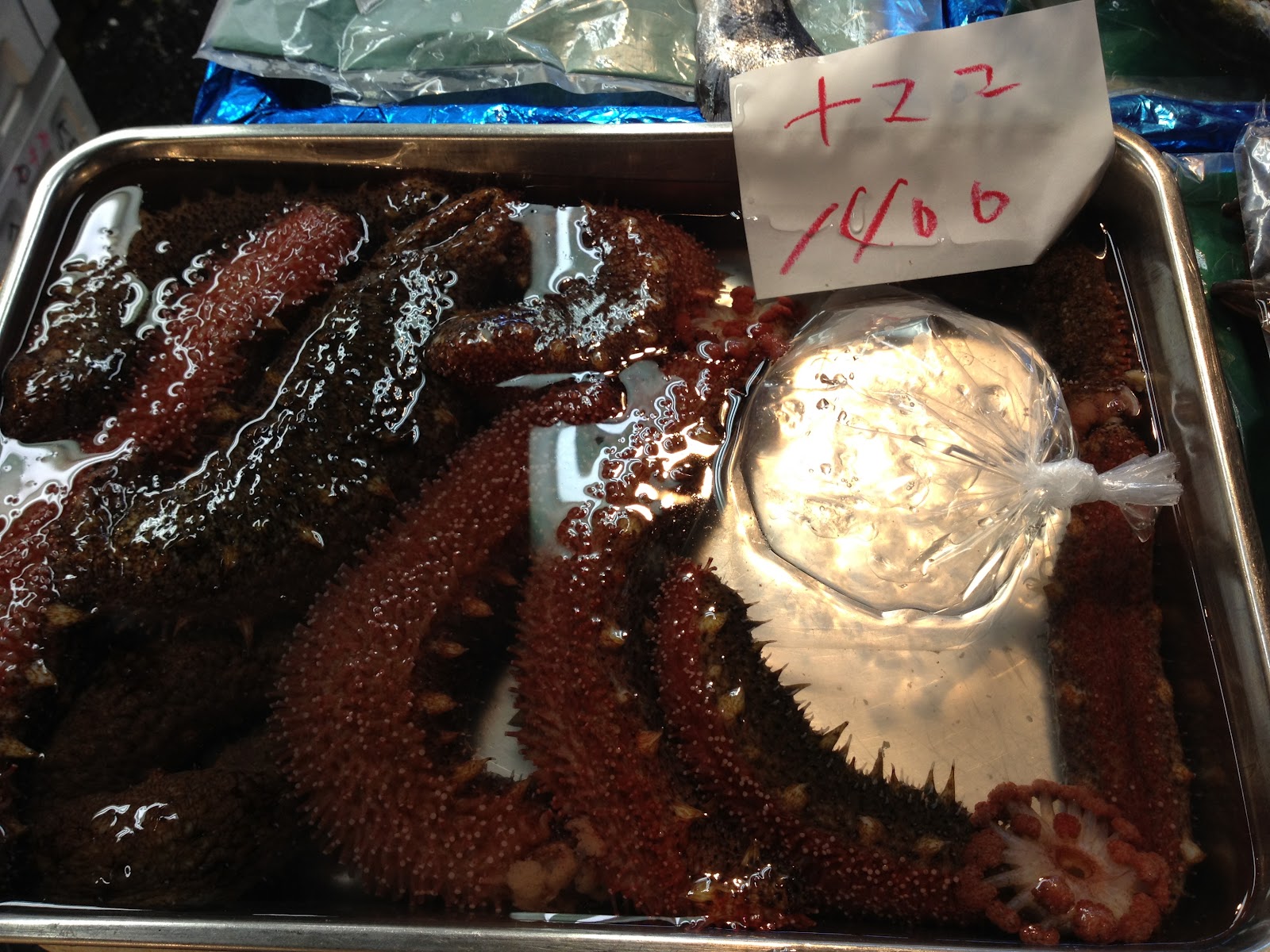
By the time I was done exploring the area around the Fish Market it was already 9 a.m. so I finally could enter the Seafood Wholesalers Area. There were a lot of seafood that I haven't seen before.


And since the main attraction here was maguro (tuna), there were lots of shops selling fresh tuna. They look really gorgeous:


Well, continuing with weird stuffs like Hokkaido hotate:


Tsukiji Fish Market is pretty huge, but it's very easy to navigate around. Plus, there was a big map in English posted at the entrance of the Fish Market.


And if you're the type who probably could get lost easily, the policeman who are stationed at the Fish Market entrance actually gives out a free map of the Fish Market, written in both Japanese and English.


Below is the enlarged version of the map:


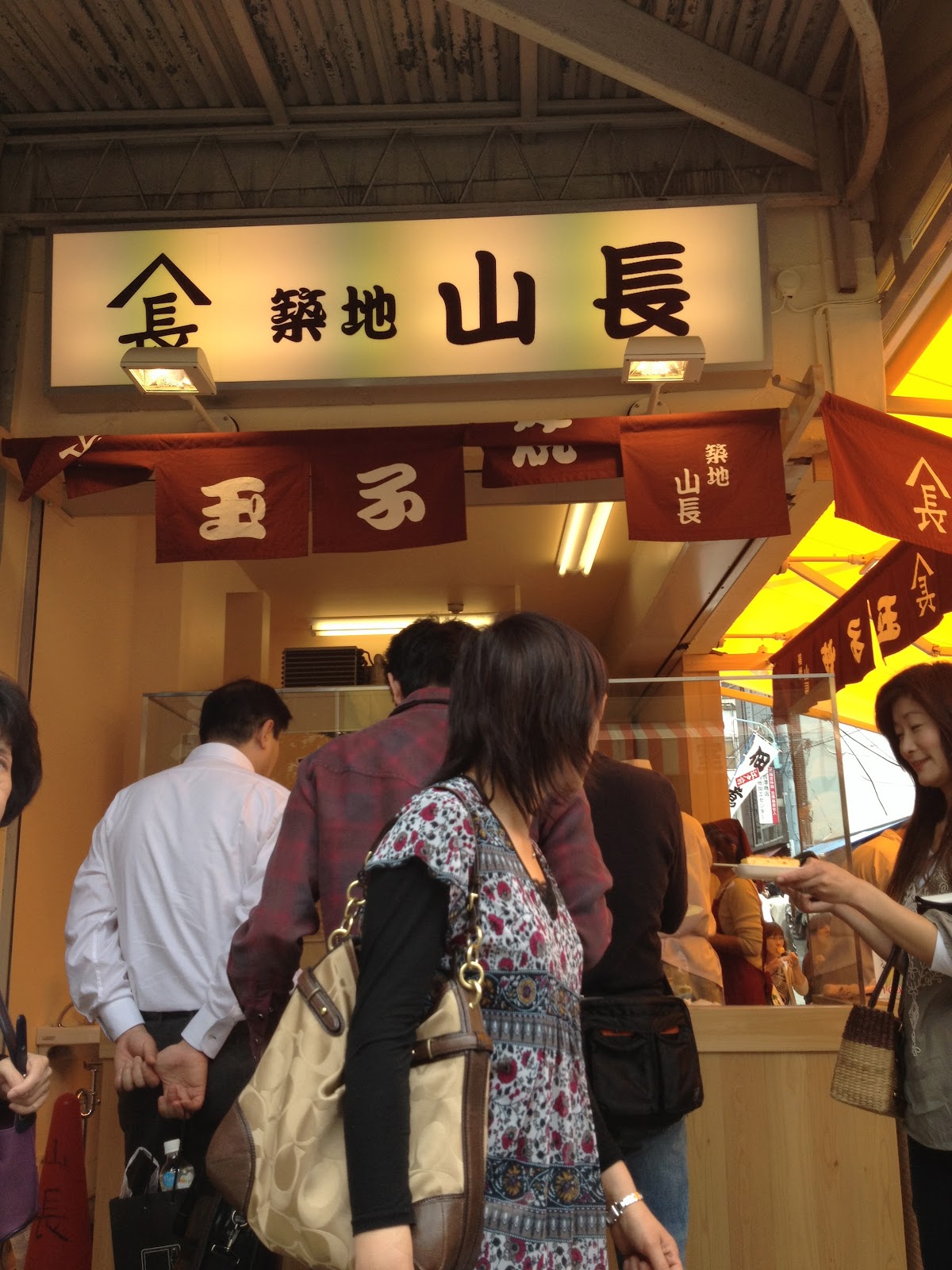
Because I came too early no shops were open but as I headed back towards the station I noticed a whole section of shops filled with lots of people. I guess another big attraction in Tsukiji is yakitamago. There were quite a number of yakitamago specialty shops there.


This kushi tamago (egg on a stick) is actually very delicious and it costs 100 yen. If you have the chance and you could find this store (sorry I don't know the exact location because I was just wandering aimlessly this morning), by all means please try it :)

And I'm sorry that my phone failed me at such a critical moment. The picture was blurred >.<


Anther yakitamago shop allows its customer to try making their own yakitamago. It looked fun :)


 And close to the station there's this very delicious-looking gyuudon with very unique sauce.


I want to try it next time I go to Tsukiji (if I have a chance to go back haha). Tsukiji is a very interesting place!